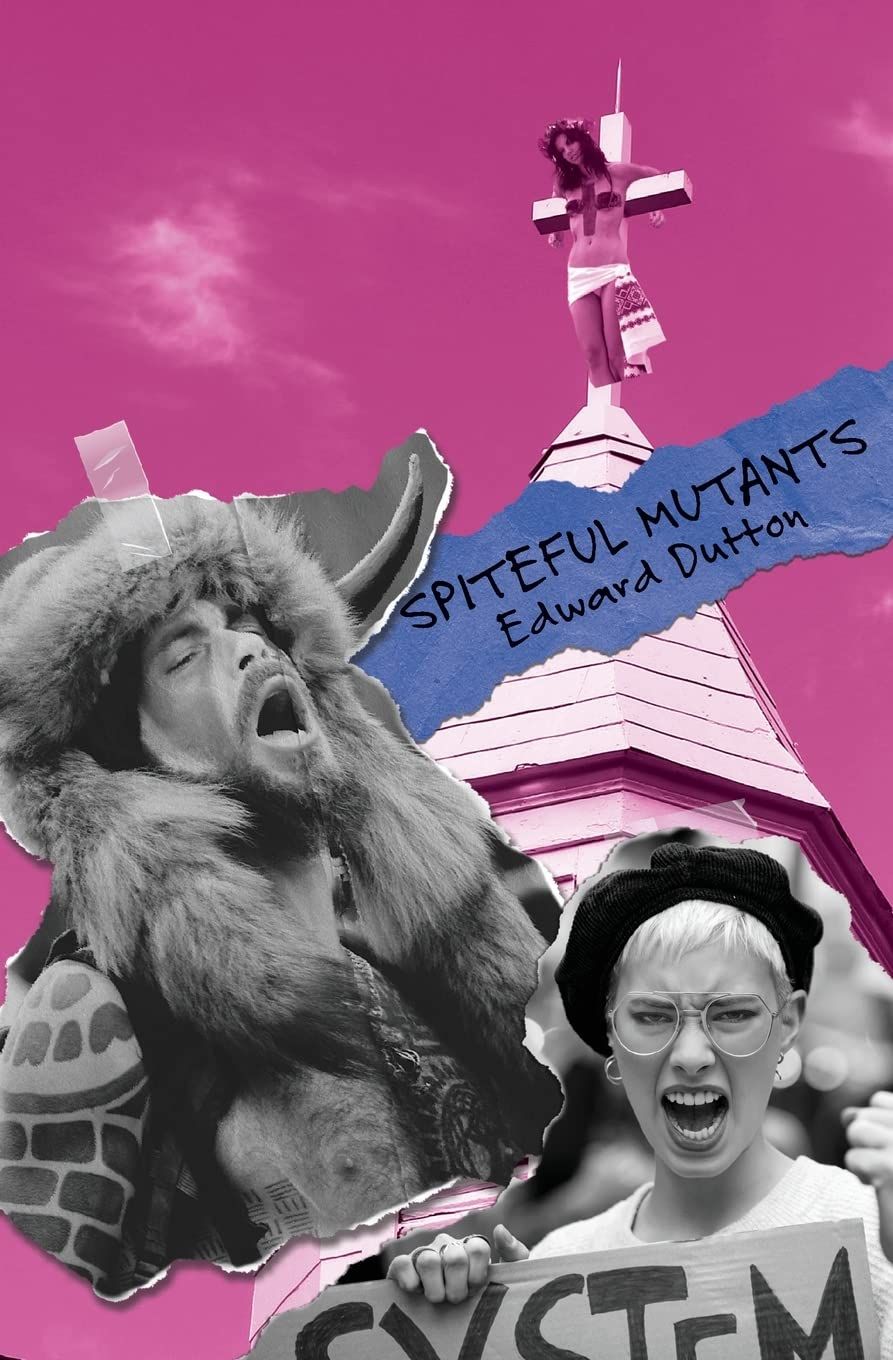
Spiteful Mutants: Evolution, Sexuality, Religion, and Politics in the 21st Century
£14.99
DUTTON, EDWARD
Save this product for later
Spiteful Mutants: Evolution, Sexuality, Religion, and Politics in the 21st Century
Product Details
ISBN: 9781593680831
Author: DUTTON, EDWARD
Pages: 377
Every zombie movie carries a chilling underlying message: the enemy isn't supernatural or extraterrestrial. "The enemy is . . . us!" The "undead" — mutated humans, grotesque versions of their former selves — wreak havoc, destroying everything in their path and leading to the collapse of civilization. Even more terrifying, they are contagious, gradually assimilating the few survivors into their ranks.
A "Zombie Apocalypse" in Modern Civilization
In Spiteful Mutants, evolutionary psychologist Edward Dutton argues that humanity is facing its own version of a "zombie apocalypse." The critical threat to civilization, he posits, comes not from external enemies but from nihilistic and self-destructive tendencies within our own populations.
Through a Darwinian lens, Dutton explores key social phenomena such as:
- BLM and QAnon
- Individuals pursuing sexual transformation
- Incels who abstain from sex altogether
- Atheists and those with religious zeal for "social justice"
These behaviors, Dutton claims, are genetic consequences of the Industrial Revolution.
Evolution and the Rise of "Spiteful Mutants"
Human evolution is a continuous process, shaped by the forces of natural selection in a given environment. Before industrialization, child mortality served as a natural filter for evolution: those who were physically or mentally unwell — carrying high levels of genetic mutation — rarely survived into adulthood.
The Industrial Revolution, coupled with medical advancements, drastically reduced child mortality. This allowed the unchecked proliferation of individuals with significant genetic mutations. These mutants, who would not have otherwise survived, now walk among us.
Dutton describes these individuals as "spiteful mutants" — not just carriers of mutations but disruptors of societal cohesion. Their influence manifests in:
- Polarization and chaos
- Depravity and dysphoria
- Declining fertility rates
A new specter haunts the industrialized world: the specter of Spiteful Mutants, a menace born from our own progress.
Praise for Spiteful Mutants
"A ripping yarn, though a handsomely footnoted, scientific one. There is also a seductive, meta-level lesson hidden in plain sight. Until and unless opinion leaders return to a biologically informed survivalism, the West will continue to decline."
Dr. Frank Salter
Formerly of the Max Planck Institute
About the Author
Edward Dutton, Professor of Evolutionary Psychology at Asbiro University, was born in London in 1980. He studied Theology at Durham University and earned a PhD in Religious Studies at Aberdeen University in 2006. Now based in Oulu, northern Finland, Dutton is a prolific author whose works include:
- Making Sense of Race (2020)
- Witches, Feminism, and the Fall of the West (2021)
- Islam: An Evolutionary Perspective (2021)
Among many others, his writings delve into the intersections of evolution, psychology, and societal change.
You May Also Like

The Quaker Question: Exposing the Sect That Really Rules the World
The Quaker Question: Exposing the Sect That Really Rules the World
DUTTON, EDWARD & RAYNER-HILLES, J.O.A
£13.99




Display prices in:GBP