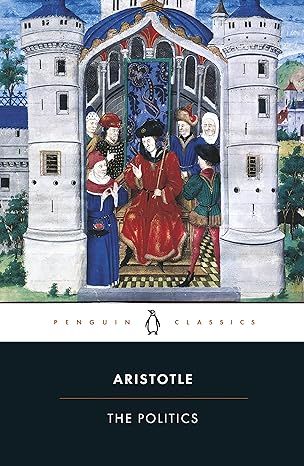
The Politics (Penguin Classics)
£12.99
ARISTOTLE
Save this product for later
The Politics (Penguin Classics)
Product Details
ISBN: 9780140444216
Author: ARISTOTLE
Raising questions that are as relevant to modern society as they were to the ancient world, Aristotle's The Politics remains central to the study of political science millennia after its compilation. This Penguin Classics edition is translated from the Greek by T.A. Sinclair and revised and re-presented by Trevor J. Saunders.
Core Themes of The Politics
In The Politics, Aristotle addresses questions that lie at the heart of political science, such as:
- How should society be ordered to ensure the happiness of the individual?
- Which forms of government are best, and how should they be maintained?
By analyzing a range of city constitutions—including oligarchies, democracies, and tyrannies—Aristotle seeks to identify the strengths and weaknesses of each system. His goal is to determine which systems are most effective, both in theory and in practice.
Like his predecessor Plato, Aristotle believed that the ideal constitution should:
- Be good in itself and in accordance with nature.
- Be necessary for man, described as a 'political animal', to fulfill his potential.
A hugely significant work, The Politics has influenced thinkers as diverse as Thomas Aquinas and Machiavelli. It remains an outstanding commentary on fundamental political issues and concerns, offering fascinating insights into the workings and attitudes of the Greek city-state.
Additional Features of This Edition
This edition includes:
- Introductions by T.A. Sinclair and Trevor J. Saunders, which discuss the influence of The Politics on philosophers, its modern relevance, and Aristotle's political beliefs.
- Greek and English glossaries for reference.
- A bibliography for further reading.
About Aristotle
Aristotle (384–322 BC) was born in Stagira, in the dominion of the kings of Macedonia. For twenty years, he studied at Athens in Plato's Academy. Later, he became the tutor of the young Alexander the Great.
His writings—including De Anima, The Nicomachean Ethics, Poetics, and The Politics—profoundly influenced the course of ancient and medieval philosophy.
If You Enjoyed This Book
If you enjoyed The Politics, you might also like Plato's Republic, also available in Penguin Classics.
You May Also Like
On Sale

Philosophy for Life: And other dangerous situations
Philosophy for Life: And other dangerous situations
EVANS, JULES
was £12.99
Save 62%
£5.00
Display prices in:GBP