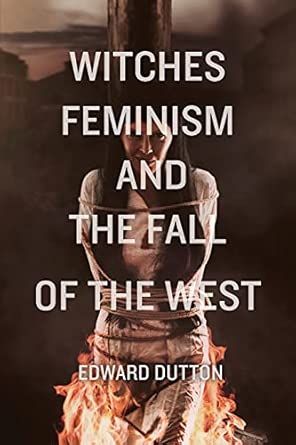
Witches, Feminism, and the Fall of the West
£18.99
DUTTON, EDWARD
Save this product for later
Witches, Feminism, and the Fall of the West
Product Details
ISBN: 9781593680794
Author: DUTTON, EDWARD
Pages: 306
The archetype of the "witch" is burned deep into the European psyche, recurring again and again in folklore and fairytales. But is she merely the stuff of fantasy? Roald Dahl warned that witches don't always don black hats and ride on broomsticks. They "dress in ordinary clothes, and look very much like ordinary women. . . . That is why they are so hard to catch."
A Historical and Psychological Examination of Witches
In Witches, Feminism and the Fall of the West, Edward Dutton examines the history of witches and witch-hunting through the lens of evolutionary psychology. Across the centuries, witches were ostracized throughout Europe and often condemned and executed for:
- Sorcery
- Harming children
Witches generally adhered to a specific type:
- Low-status
- Anti-social
- Childless
Their very presence was viewed as poisonous to the community. Dutton demonstrates that witches, in their way, represented a maladaptive mentality and behavior, undermining Europe's patriarchal system. When times grew tough—when Europe became poorer or colder—witches were persecuted with a vengeance.
The Modern Witch
Today, the evolutionary situation has been turned on its head. The intense selection pressures of the past have been overcome by the Industrial Revolution and its technological advancements. Modern witches now survive and thrive in the postmodern West, still driven by the motivations and dispositions of their historical counterparts.
What was once considered "sorcery"—nihilism and self-hatred—is no longer taboo. Instead, it has become a high-status ideology. Roald Dahl's warning remains eerily accurate: witches do exist, and they mean to do us harm.
You May Also Like
On Sale
The Great Unravelling: Why Democracy Failed and How to Fix It.
The Great Unravelling: Why Democracy Failed and How to Fix It.
RUECHEL, JULIUS
was £8.99
Save 44%
£5.00



Available approx mid October
One Man in: The Explosive Firsthand Account of the Lone Special-Ops Commando Who Fought Off a Major Terrorist Attack in Kenya - Hardcover
One Man in: The Explosive Firsthand Account of the Lone Special-Ops Commando Who Fought Off a Major Terrorist Attack in Kenya - Hardcover
CRAIGHEAD, CHRISTIAN
£22.99
Display prices in:GBP